
Nanoscale films of a pure metal exist in two stable optically distinguishable states

Nanoscale films of a pure metal exist in two stable optically distinguishable states
Image
nanoscale films oxf photonics

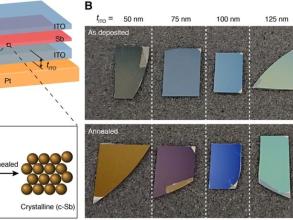
Oxford scientists have demonstrated for the first time that nanoscale films of a pure metal, Antimony (Sb), can exist in two optically distinguishable states at room temperature, and can then also be programmed with both electrical signals and optical sub-picosecond pulses.

This non-trivial discovery has been made by a team of scientists in Materials and Engineering Science at the University of Oxford. Their paper, Antimony thin films demonstrate programmable optical non-linearity, published recently in Science Advances, is the first to report on this surprising optical switching at the nanoscale.

Such switching of a single-metallic element between two highly distinguishable, stable optical states at room temperature provides an immediately applicable material for nanoscale devices. Previous work on Antimony had so far achieved only electronic switching at cryogenic temperatures, which in itself was extremely novel.

Lead author Zengguang Cheng, formerly a postdoctoral researcher at Oxford and now Associate Professor at Fudan University, China, explains: "By using the group's insight into the materials switching, we have demonstrated we can tune the volatility of the switching and thus easily and readily reach room temperature switching. This is a very significant advance that can take a pure metal into immediate photonics and optoelectronics applications at the nanoscale".

The group's earlier paper published in Nature in 2014, was one of the first to show this effect in alloys, named phase-change materials (PCMs), generating an entirely new area of phase-change optoelectronics. While other such PCMs suffer from miniaturisation limitations due to segregation of alloys, the scientists have shown that Antimony is potentially a more reliable tuneable optical material with ultra-fast and reversible switching and high energy efficiency.

Tara Milne, who worked on the project as a MEng researcher, won the Society of Glass 2020 Oldfield Prize for her work on this. She adds, "The use of Antimony as a metal is much more promising - it is manufacturable, compatible with optoelectronics, as well as plasmonics and can be used as both the electrode and as the active material. These are unprecedented possibilities that previous work do not even predict".

This find of active and non-linear optical tunability in metallic states will benefit a wide range of applications, making them faster, energy efficient and reversible. Such technologies that could benefit from this finding include optical coatings, plasmonic antenna, metasurfaces, high resolution imaging, biosensors, integrated photodetectors and modulators. Harish Bhaskaran, Professor of Applied Nanomaterials, who led the research, adds that,"What's really phenomenal is that this work was curated by two undergraduate students, Samuel Humphrey and Tara Milne. Curiosity driven research leads to real learning, not just for the students but for all of us." 

Martin Booth, Professor of Engineering Science concludes: "This is very exciting work which has the potential for immediate applications, while also drawing interest into a new field of research into the optical properties and states of metallic thin films."

This research was supported via EPSRC grants.

Read 'Antimony thin films demonstrate programmable optical non-linearity' in Science Advances.

Placeholder

Light-carrying chips advance machine learning

A team of international scientists have demonstrated an initial prototype of a photonic processor
Placeholder

Nanoscale films of a pure metal exist in two stable optically distinguishable states

Oxford scientists have demonstrated for the first time that nanoscale films of a pure metal, Antimony (Sb), can exist in two optically distinguishable states at room temperature
professor simon hooker

Professor Simon Hooker awarded IOP Medal

Congratulations to Professor Simon Hooker who has been awarded the 2020 Cecilia Payne-Gaposchkin Medal and Prize
karen hampson

Senior Researcher Karen Hampson on Building Connections

Senior Research Karen Hampson is Chair Elect of the Applications of Visual Science OSA Technical Group
oxhighq3

Oxford Spin-out wins IOP Business Award

Oxford Spin-out HighQ (co-founders Professors Jason Smith and Claire Vallance) wins IOP Business Award
Madhavi Krishnan

Professor Madhavi Krishnan wins Royal Society of Chemistry Prize

Congratulations to Professor Madhavi Krishnan for winning the 2020 Royal Society of Chemistry Corday-Morgan Prize
the oxford trust awards 2019 075 2

Laser Writing Spin-out wins Start-up Award

Department of Engineering Science Spin-out Opsydia (co-founders Professor Martin Booth and Dr Patrick Salter) wins Oxford Tust Start-up award
johnstanford

Prestigious IET Award for DPhil student in Engineering

John Sandford O'Neill has been announced as the recipient of an Institution of Engineering and Technology (IET) Postgraduate Award
Ian Dobbie

Dr Ian Dobbie wins the RMS Vice-President's medal 2019

Dr Dobbie has made a unique and outstanding contribution to both running the Oxford-wide Micron imaging facility
diamond marking

Oxford Spin-Out Opsydia in the News

Oxford Engineering Spin-out Opsydia featured in the BBC Business article: How do you know your diamond isn't fake?
op icon

Oxford Photonics Day 2019

2019 Photonics Day - Wednesday 24th April
Donal Bradley CBE FRS

Professor Donal Bradley awarded the E-MRS 2019 Jan Czochralski award

The Award Presentation Ceremony will take place on September 18, 2019
Placeholder

Light-carrying chips advance machine learning

A team of international scientists have demonstrated an initial prototype of a photonic processor
Placeholder

Nanoscale films of a pure metal exist in two stable optically distinguishable states

Oxford scientists have demonstrated for the first time that nanoscale films of a pure metal, Antimony (Sb), can exist in two optically distinguishable states at room temperature
professor simon hooker

Professor Simon Hooker awarded IOP Medal

Congratulations to Professor Simon Hooker who has been awarded the 2020 Cecilia Payne-Gaposchkin Medal and Prize
karen hampson

Senior Researcher Karen Hampson on Building Connections

Senior Research Karen Hampson is Chair Elect of the Applications of Visual Science OSA Technical Group
oxhighq3

Oxford Spin-out wins IOP Business Award

Oxford Spin-out HighQ (co-founders Professors Jason Smith and Claire Vallance) wins IOP Business Award
Madhavi Krishnan

Professor Madhavi Krishnan wins Royal Society of Chemistry Prize

Congratulations to Professor Madhavi Krishnan for winning the 2020 Royal Society of Chemistry Corday-Morgan Prize
the oxford trust awards 2019 075 2

Laser Writing Spin-out wins Start-up Award

Department of Engineering Science Spin-out Opsydia (co-founders Professor Martin Booth and Dr Patrick Salter) wins Oxford Tust Start-up award
johnstanford

Prestigious IET Award for DPhil student in Engineering

John Sandford O'Neill has been announced as the recipient of an Institution of Engineering and Technology (IET) Postgraduate Award
Ian Dobbie

Dr Ian Dobbie wins the RMS Vice-President's medal 2019

Dr Dobbie has made a unique and outstanding contribution to both running the Oxford-wide Micron imaging facility
diamond marking

Oxford Spin-Out Opsydia in the News

Oxford Engineering Spin-out Opsydia featured in the BBC Business article: How do you know your diamond isn't fake?
op icon

Oxford Photonics Day 2019

2019 Photonics Day - Wednesday 24th April
Donal Bradley CBE FRS

Professor Donal Bradley awarded the E-MRS 2019 Jan Czochralski award

The Award Presentation Ceremony will take place on September 18, 2019